Why Smart Homes Need Cyber Architecture
Every connected device is a door. A well-designed home knows where all of them are.
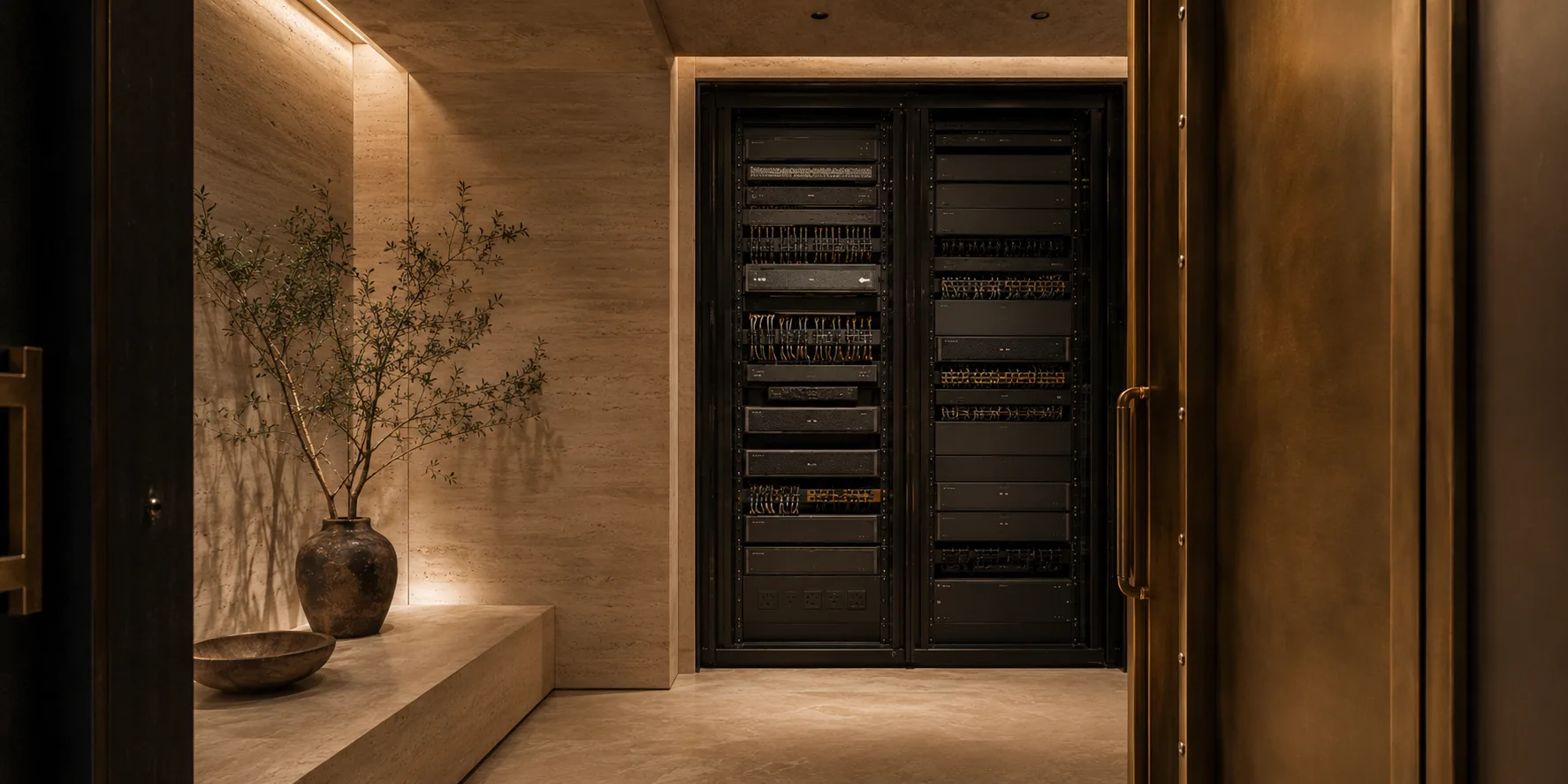
A house full of quiet doors
A modern luxury home is, in effect, a small data center that happens to have bedrooms. Lighting, climate, shades, locks, cameras, audio, the gate, the pool, the wine room - all networked, many of them tied to the cloud, most of them shipped with security as an afterthought.
Each of those devices is a door. And those doors are being walked through at scale.
The numbers are not small. Americans reported $16.6 billion in losses to internet crime in 2024, about a third more than the year before.5 A great deal of that is ordinary fraud - a convincing email, a redirected wire, a stolen identity. The more a household transacts, and the more staff and vendors touch its accounts, the larger that exposure becomes.
The devices themselves are a target
It is not only inboxes. The connected devices in a home have become targets in their own right.
In 2024, U.S. agencies disrupted a botnet, run by a company based overseas, that had quietly taken over more than 260,000 ordinary devices - home routers, cameras, video recorders, and storage drives - and used them as cover for other attacks.10 In 2025, the FBI warned that some consumer gadgets arrive already infected: streaming boxes, projectors, even digital picture frames, conscripted into a criminal network the moment they are plugged in.11
You did not have to be careless. In many cases you only had to buy the thing and turn it on.
And the tools keep advancing. In late 2025, the AI company Anthropic disclosed that a state-linked group had manipulated its own technology into running a large cyber-espionage campaign against roughly thirty organizations, with the AI carrying out most of the work.6 The lesson is not that one company had a problem. It is that the capability now exists - and capability spreads.
The fix is architecture, not anxiety
The reassuring part is that a connected home can be made resilient with good design. None of it requires a household to become technical. It requires the home to be built the way a serious organization builds a network.
A wired backbone. Run the home on structured cabling. Wired connections cannot be jammed from the street, are far harder to intercept, and do not broadcast the network to anyone parked outside. Reserve Wi-Fi for convenience, never for the security layer.
Separated lanes. The family's phones and laptops, the security system, and the smart-home gadgets should live on separate, isolated networks. That way a compromised lightbulb or a pre-infected picture frame cannot reach the cameras, the locks, or the device where the family reads email.
A real firewall. Not the plastic box the internet provider left in a closet, but a proper, business-grade firewall that inspects traffic and enforces the rules between those lanes.
Revocable keys. Every integrator, every service company, every platform that can touch the home's systems is a path in. Each should have its own credentials that can be turned off, with strong authentication and a record of who did what. The contractor who installed the system should not keep a permanent key to the house.
A living inventory. Someone - ideally a professional, under contract - should keep a current list of every connected device, its software, and its passwords, and should change the factory defaults. Many of the largest attacks have succeeded simply because no one ever did.
An offline copy of what matters. The irreplaceable material - financial records, legal documents, the family archive - belongs on storage that is encrypted and, for the most sensitive copy, physically disconnected from any network. A backup that is not connected cannot be reached by someone who is not in the room.
The blunt version
You would not let a stranger keep a key to your front door. A connected home with factory passwords, a single flat network, and a dozen vendors holding standing access is exactly that, multiplied.
Treat cybersecurity as part of the home's security, because it is. Done well, it disappears into good architecture - and the family simply experiences a home that works, and keeps working, without ever thinking about why.
References
- FBI IC3 (2024) - 2024 Internet Crime Report / FBI Releases Annual Internet Crime Report, FBI Internet Crime Complaint Center. Source ↗
- Anthropic (2025) - Disrupting the first reported AI-orchestrated cyber espionage campaign, Anthropic. Source ↗
- NSA/FBI/CNMF (2024) - PRC-Linked Actors Compromise Routers and IoT Devices (joint advisory), NSA, FBI, and Cyber National Mission Force. Source ↗
- FBI IC3 (2025) - BADBOX 2.0 - pre-infected consumer devices (public service announcement), FBI Internet Crime Complaint Center. Source ↗
Published by The New Estate Standard Institute LLC as part of The New Estate Standard. A research and education resource - not security, legal, cyber, insurance, or building advice, and not a substitute for qualified professionals who know your situation.